
The New Materials Changing Everything Around You
You woke up this morning and touched dozens of materials that didn’t exist fifty years ago.
The screen you’re reading this on is coated in a scratch-resistant glass that was originally developed for car windshields, reformulated in 2007 at the request of a tech executive who wanted something tough enough to survive a pocket full of keys. The running shoes gathering dust by your door contain a foam engineered at the molecular level, its cells are tuned to collapse and spring back faster than any natural rubber. The cables inside your walls carry electricity through copper drawn to tolerances measured in microns, insulated by polymers designed to last a century.
We live inside a materials revolution. It’s just quiet enough that most people haven’t noticed.
Let’s start with five innovations hiding in plain sight.
The glass that bends without breaking
The cover glass on modern smartphones is a masterpiece of applied chemistry, and almost nobody knows it.
Conventional glass breaks because when a crack starts at the surface, a tiny scratch, an invisible nick, it propagates. Stress concentrates at the crack tip and splits the material apart. The solution isn’t to make glass harder. It’s to put the surface under compression so cracks can’t open in the first place.
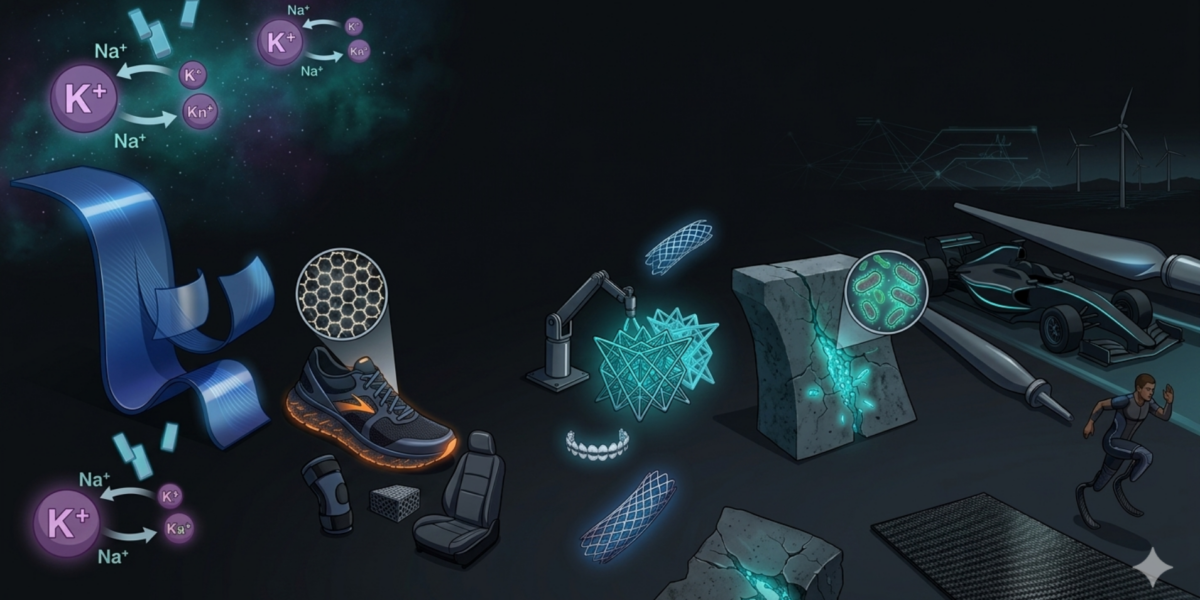
Chemically strengthened glass achieves this through ion exchange: the glass is submerged in a bath of molten potassium salt at around 400°C. Potassium ions, which are physically larger, swap places with sodium ions at the surface. When the glass cools, those oversized ions are locked in place, and the compression they create acts like a permanent pre-stress,a kind of molecular armor.
The result can withstand pressures that would shatter ordinary glass. When it does eventually break, it tends to crumble into small, blunt fragments rather than long razor-edged shards. The same principle now appears in car windshields, architectural facades, and submarine viewports. One material chemistry adapted endlessly.
The foam that launched a billion-dollar industry
Before the early 2010s, running shoe midsoles were made from ethylene-vinyl acetate (EVA) foam, a technology that had barely changed since the 1970s. Then materials engineers started asking a different question: what if we could control the foam’s structure at the microscale?
Modern performance foams use expanded thermoplastic polyurethane or proprietary nitrogen-infused compounds where the cell structure, the size, shape, and distribution of the tiny air pockets ,is engineered rather than left to chance. Smaller, more uniform cells return energy more efficiently. The foam compresses under load and rebounds fast enough to assist the stride.
The record-breaking marathon times of the past decade aren’t only about the runners. They’re partly a materials story. The same engineering logic has since migrated into bicycle helmets, knee braces, car seats, and mattresses. When you optimize the invisible architecture inside a material, the performance gains ripple outward in ways the original designers couldn’t anticipate.
The metal that remembers its shape
Imagine bending a piece of metal into a new shape, warming it up, and watching it bend itself back. That’s not a magic trick. It’s nickel-titanium alloy, commercially known as Nitinol ,and it belongs to a family called shape memory alloys.
The material undergoes a reversible phase transformation: at low temperatures its crystal structure is malleable; heat it above a critical temperature and the structure snaps back to its original configuration, generating a surprisingly powerful mechanical force as it does.
Nitinol entered the medical world first: orthodontic wires that apply gentle, consistent force as they warm to body temperature; stents that are crimped small, inserted into a blood vessel, and then expand to their programmed diameter. In aerospace, shape memory alloys are used as actuators, components that move in response to temperature changes without motors, gears, or wires.
If you’ve had a tooth straightened with a modern wire brace, you’ve experienced shape memory alloy at work.
The concrete that heals itself
Concrete is the most used construction material in history, and it has a problem: it cracks. Not catastrophically, usually, just tiny fractures from thermal expansion, vibration, and settling. Left unaddressed, water gets in, steel reinforcement rusts, and a slow structural deterioration begins. The cost of repairing aging concrete infrastructure globally runs into the trillions.
One compelling solution borrows from biology: concrete embedded with dormant bacteria and their food source, sealed in clay pellets. When a crack forms and water enters, it breaks the capsules. The bacteria wake up, consume the calcium compound, and produce calcite, limestone, as a metabolic byproduct. The crack fills itself.
Self-healing concrete is now commercially available in several countries. It costs more upfront. Over the lifetime of a structure, it costs significantly less.
This is a pattern you’ll see throughout this series: the most interesting materials advances don’t just make things stronger or lighter or more conductive. They make materials behave, respond, adapt, repair. The line between a material and a system is quietly dissolving.
The fiber that changed what strength means
For most of engineering history, strong meant heavy. Steel is strong; steel is dense. The tradeoff felt fundamental.
Carbon fiber reinforced polymer broke the equation. Carbon fiber is composed of long chains of carbon atoms aligned in a crystal structure along the fiber’s axis, that alignment is what gives it extraordinary stiffness and tensile strength at a fraction of steel’s weight. Embed those fibers in an epoxy matrix, orient them precisely for the loads a structure will experience, and you have a material that is, pound for pound, among the strongest ever made.
CFRP was once so expensive it appeared only in military aircraft and Formula 1 cars. The cost curve has since collapsed. It’s now in commercial aircraft fuselages, bicycle frames, wind turbine blades, and orthopedic prosthetics.
A carbon fiber running blade doesn’t try to replicate a human leg. It stores elastic energy on impact and releases it on push-off in a way no biological ankle could. It’s a material solution that reimagines the problem from the ground up.
Why this decade is different
Every decade has produced materials advances. What makes right now unusual is the convergence.
Computational tools can now simulate material properties at the atomic scale before anything is synthesized. Machine learning models are predicting novel compounds with useful properties faster than any lab could screen them experimentally. Additive manufacturing lets engineers place material exactly where it’s needed, in geometries impossible to machine. And sustainability pressures are forcing a rethink of every supply chain and production process.
The pace is accelerating in a way it hasn’t since the mid-20th century when synthetic polymers and semiconductors reshaped the world in a generation. The next ten years will likely see solid-state batteries in production vehicles, structural materials grown from living organisms, and AI-designed compounds entering clinical trials. Most will be invisible to the people who benefit from them, embedded in products, hidden in infrastructure, doing their work quietly.
Which is exactly why it’s worth paying attention now.
For more information or if you have any questions, please contact the author.