
Smart Materials: The Stuff That Remembers, Bends, and Responds
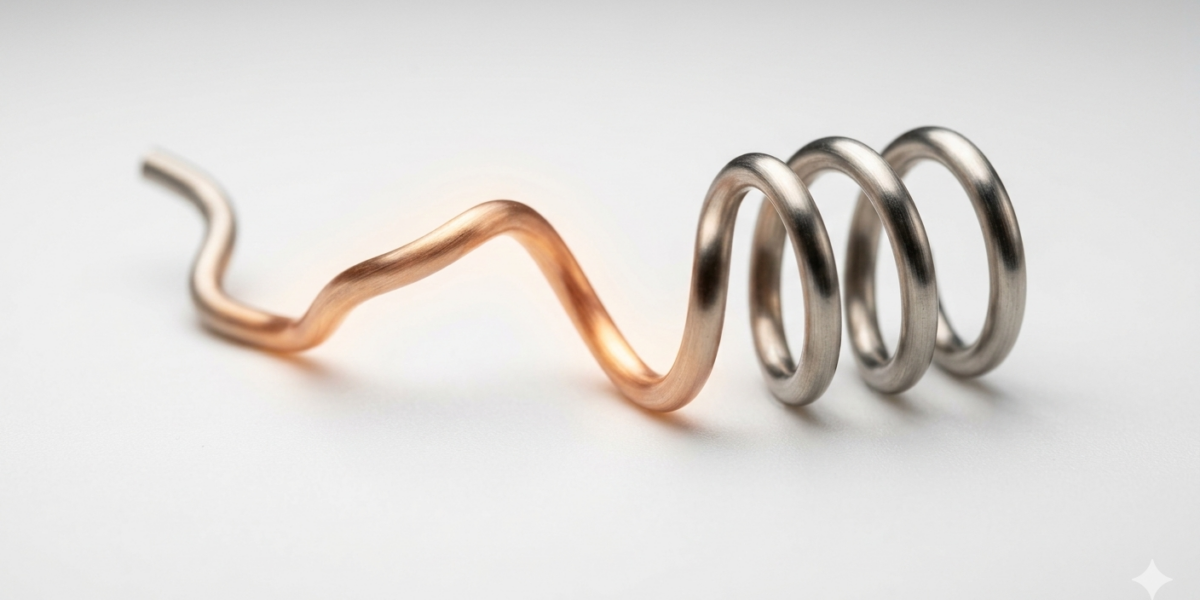
A piece of wire sits coiled in a tray. You bend it out of shape. Then a nurse holds it near a patient’s body, and it bends itself back.
That’s not a magic trick. It’s engineering. And it points to something genuinely new in materials science: the idea that a material doesn’t just sit there. It can respond.
Most materials are passive. Steel holds its shape. Glass transmits light. Copper conducts electricity. They do what they’re told, and nothing more. Smart materials are different. They sense a change in their environment, temperature, pressure, electric field, light, and they react. Sometimes that reaction is mechanical. Sometimes chemical. Sometimes both.
They are, in a real sense, materials that do something.
This article covers three families you’ll encounter more and more over the next decade: shape memory alloys, piezoelectrics, and self-healing polymers. Each one works differently. Each one is quietly changing a different corner of the engineered world.
What makes a material “smart”
The word “smart” gets applied to almost everything now, so it’s worth being precise.
A smart material is a material whose properties change in a controlled, reversible way in response to an external stimulus. The key word is reversible. A material that melts when you heat it isn’t smart. One that changes shape when heated and then changes back when cooled is.
The stimulus can be almost anything: temperature, stress, electric field, magnetic field, moisture, pH, or light. The response can be a change in shape, stiffness, conductivity, color, or optical transparency. What makes the category scientifically interesting is that the response is predictable, programmable, and in most cases tunable. You can design it in.
That’s the distinction that matters to engineers. Not just that the material responds, but that you can specify exactly what the response will be.
Shape memory alloys: the metal that remembers
You first met Nitinol in the previous article. Here’s how it works.
Nitinol, roughly 55% nickel and 45% titanium by weight, exists in two distinct crystal phases. Below a critical temperature it’s martensite: a soft, easily deformed structure where atoms can shift position under stress. Above that temperature it transforms to austenite: a stiffer, more ordered structure. The two phases have different shapes at the atomic scale.
When you bend a Nitinol wire in its martensite phase, you’re rearranging atoms into a new configuration. The wire holds that shape. Heat it above the transition temperature, typically somewhere between 40°C and 100°C depending on the exact alloy composition, and the crystal structure reverts to austenite. The atoms snap back to their original positions. The wire unbends.
The engineering insight is that you can tune the transition temperature by adjusting the nickel-titanium ratio and by adding small amounts of other elements. Copper shifts it down. Palladium shifts it up. In medical applications, the target is body temperature (37°C), so the wire transforms the moment it’s implanted.
Medical uses
Orthopedic staples that clamp bone fragments together more tightly as they warm. Stents crimped down to 2mm in diameter for catheter delivery, then self-expanding to 20mm once deployed. Guidewires that navigate the curves of the vasculature without kinking. The global market for Nitinol medical devices exceeded $3 billion in 2023, and it’s still growing.
Aerospace and mechanical uses
Actuators that replace motors entirely: components that move in response to a temperature change, with no power supply, no gears, no electronics. NASA has used SMA actuators in deployable structures for satellites and in morphing wing concepts where the wing profile changes shape in flight. Boeing and Airbus both have active development programs.
Manufacturing
Making Nitinol is expensive. The raw materials aren’t rare, but the production is unforgiving. The alloy is melted under vacuum to prevent oxidation, then repeatedly hot-worked and cold-worked to develop the right microstructure. Small deviations in composition shift the transition temperature by several degrees, which in medical applications is clinically significant. That precision is why Nitinol wire can cost 10 to 100 times more than stainless steel.
The limitation
Fatigue. SMA actuators that cycle repeatedly, heating and cooling thousands of times, gradually accumulate microstructural damage. The transformation temperature drifts. The recoverable strain decreases. For applications like a one-time deployable stent, that’s fine. For high-cycle applications like a morphing aircraft wing, it’s a real engineering constraint.
Piezoelectrics: the material that generates electricity when you squeeze it
Press on a piezoelectric crystal and it generates a voltage. Apply a voltage and it deforms. That two-way coupling between mechanical stress and electrical charge is called the piezoelectric effect, and it was first described by Pierre and Jacques Curie in 1880.
The physics: in certain crystal structures, the positive and negative charge centers are offset from each other. Under no stress, the offsets cancel out. Apply a force, distort the lattice, and the offsets no longer cancel. A net electric dipole appears. Charge accumulates at the crystal surfaces. That’s a voltage.
Run it in reverse: apply a voltage, and the resulting electric field pulls the charge centers in opposite directions, distorting the lattice. The material deforms. In lead zirconate titanate (PZT), the most widely used piezoelectric ceramic, the deformation is tiny, typically 0.1% strain at most, but it can be achieved at very high frequencies with extremely precise control.
Sensors and actuators
Ultrasound transducers in medical imaging use PZT to convert electrical pulses into pressure waves and receive the echoes back. The same principle drives sonar, industrial non-destructive testing, and the inkjet print heads in your printer, where precisely timed piezoelectric pulses eject droplets with micron-scale accuracy.
Energy harvesting
Press a piezoelectric element and it generates power. This is being explored in flooring tiles under high-foot-traffic areas, in wearable sensors that harvest energy from body movement, and in wireless sensors embedded in civil structures that self-power from vibration. The energy output is modest, tens of microwatts per cycle in most practical setups, but enough for low-power electronics that would otherwise require battery replacement.
Precision positioning
Piezoelectric actuators in atomic force microscopes and electron microscopes control tip position to sub-nanometer resolution. The deformation is tiny but extraordinarily controllable. In hard disk drive read/write heads, piezoelectric positioners adjust head position to within nanometers across spinning platters.
Manufacturing
PZT is made by mixing lead, zirconium, and titanium oxide powders, pressing them into shape, and sintering at around 1200°C. After sintering, the crystals need to be polarized: heated above their Curie temperature (typically 200–350°C) and cooled under a strong electric field, which aligns the internal dipoles. This polarization can be lost if the ceramic is subsequently heated above the Curie point, which limits operating temperature in harsh environments.
The limitation
Lead. PZT contains roughly 60% lead by weight, making it subject to increasing environmental regulation. The European Union has been gradually restricting lead in electronics, and piezoelectric ceramics have only been temporarily exempted. Lead-free alternatives, barium titanate, potassium niobate, bismuth-based ceramics, exist but currently perform worse. Finding a high-performance lead-free piezoelectric is one of the more active research problems in functional materials.
Self-healing polymers: materials that repair themselves
Cut a self-healing polymer and leave it in contact with itself. Come back in hours or days and the cut is partially or fully closed. No adhesive. No human intervention. The material did it.
This sounds implausible. But biological systems do it constantly: skin, bone, cartilage, wood. The insight driving self-healing materials research is that we can build similar repair mechanisms into synthetic polymers, either by mimicking biology directly or by exploiting different chemistry entirely.
There are three main approaches, each with different tradeoffs.
Microencapsulated healing agents
Tiny capsules, 10 to 200 microns in diameter, filled with a reactive monomer, are dispersed throughout the polymer matrix. A crack propagating through the matrix ruptures the capsules, releasing the healing agent. It flows into the crack, contacts a catalyst embedded in the matrix, and polymerizes, essentially gluing the crack shut. The White-Sottos group at the University of Illinois pioneered this approach in the early 2000s. Crack healing efficiencies above 90% have been demonstrated. The problem: the capsules are one-use. Once ruptured, they can’t refill. Repeated damage at the same location goes unrepaired.
Vascular networks
Borrowing from biological anatomy, hollow channels, sometimes called vascular networks, are embedded throughout the material. They carry healing agents in a continuous supply. When damage occurs, the network delivers fresh reagent. Multiple healing events are possible at the same location. The challenge is fabricating these networks at scale without compromising the structural properties of the bulk material.
Intrinsic self-healing polymers
Rather than adding capsules or channels, these materials have self-repair built into their polymer chains. The chemistry exploits reversible bonds: Diels-Alder cycloadditions, hydrogen bonding networks, ionic interactions, disulfide exchanges. Damage breaks these bonds. The broken ends remain reactive. Bring them into contact, sometimes with a gentle heat treatment, and the bonds reform. Supramolecular polymers developed at ESPCI Paris can heal cuts at room temperature in minutes, achieving tensile strength recovery above 80%.
Where this is going
Self-healing elastomers for soft robotics, where repeated deformation causes fatigue that’s currently a major lifespan limiter. Self-healing coatings for marine structures, where corrosion costs the global economy an estimated $2.5 trillion annually. Biomedical implants that repair minor surface damage before it becomes a failure point. The constraint is always the same: healing takes time, and it reduces mechanical performance. A polymer matrix optimized for self-healing tends to be softer and more viscoelastic than one optimized purely for stiffness.
The common thread
Shape memory alloys, piezoelectrics, and self-healing polymers look very different on the surface. One is a metal, one is a ceramic, one is an organic polymer. But they share a design philosophy: the useful behavior is built into the material’s structure, not bolted on as a separate system.
A sensor doesn’t sit on top of a piezoelectric transducer. The transducer is the sensor. A self-healing polymer doesn’t carry a repair kit. The repair capacity is in the chemistry of the chains. Nitinol doesn’t need an actuator to move. The actuation is in the phase transformation.
This is what the next generation of smart structures looks like: simpler, not more complicated. Fewer components, fewer interfaces, fewer failure modes. A wing that morphs without a servo. A pipeline that seals its own pinhole leaks. A medical implant that maintains its geometry through a body’s lifetime of loading.
The challenge is cost and manufacturability. These are materials that require precise control, specialized processing, and in most cases, significant quality assurance. They’re entering commercial products wherever the performance gain justifies the cost premium. As manufacturing scales and costs fall, that range will expand.
It’s worth watching.
For more information or if you have any questions, please contact the author.